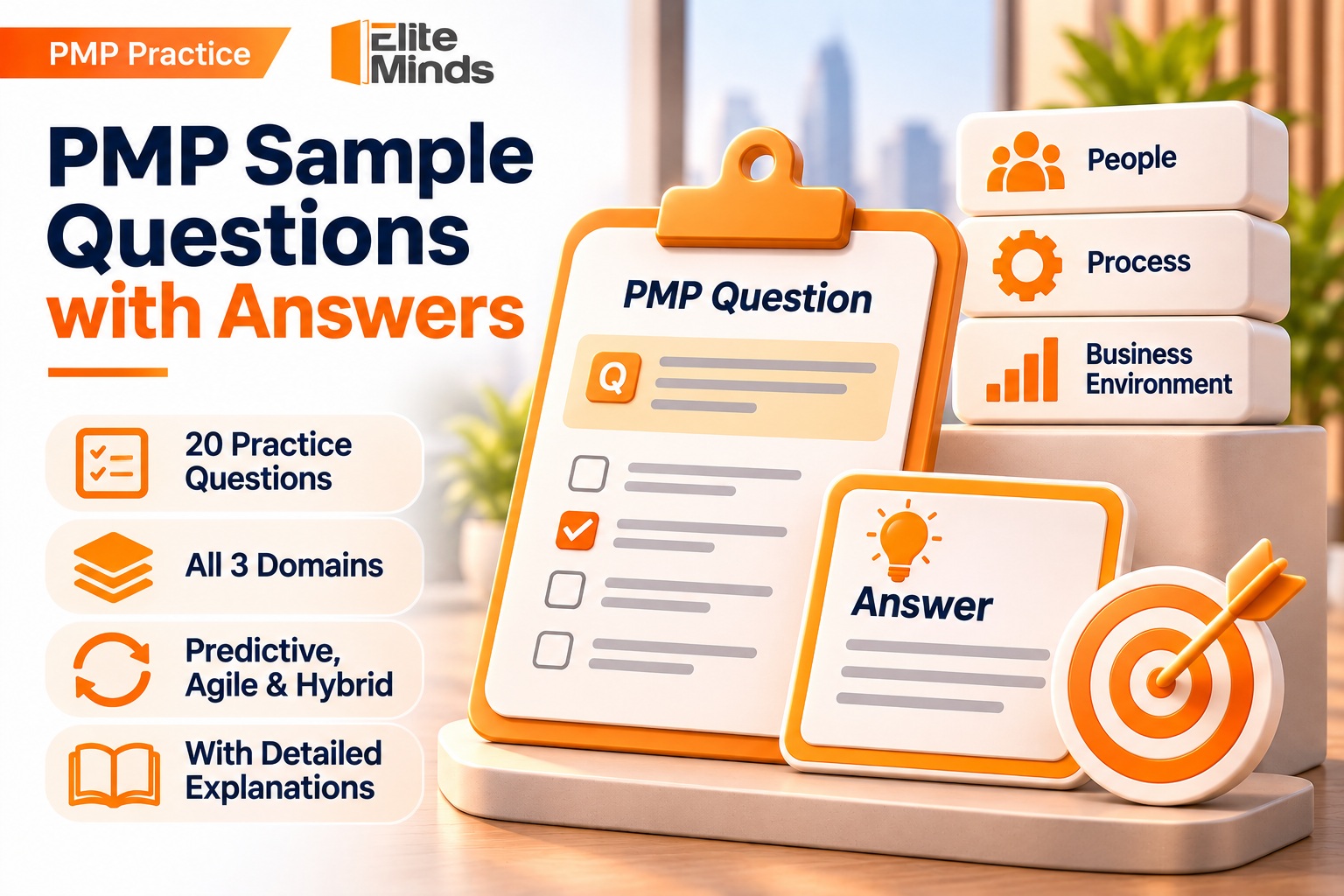
These 20 PMP exam sample questions are written in the style of real PMP exam questions: realistic project situations where you choose what a project manager should do. They cover all three exam domains, mix predictive, agile, and hybrid projects, and include a three-question case study set and two dashboard questions, the two formats that are new to the exam. Every answer comes with an explanation of why the right option is right and why the others are wrong.
These are practice questions written by Elite Minds. They are not taken from the real exam.
How to use these questions
Treat these PMP questions and answers as a study tool, not a quiz.
- Answer first, then read the explanation. Cover the answer, choose an option, and only then check it.
- Read the explanations even when you are right. The reasoning matters more than the score.
- Ask yourself what the project manager should do first or next. Many wrong options are good actions done at the wrong time.
- Watch for the approach. A question about a sprint expects agile thinking. A question about a signed baseline expects change control.
What these questions cover
| Questions | Domain | Approaches |
|---|---|---|
| 1 to 6 | People | Agile, hybrid, and predictive |
| 7 to 13 | Process (includes two dashboard questions) | All approaches |
| 14 to 17 | Business Environment | All approaches |
| 18 to 20 | Case study set (Process and Business Environment) | Hybrid |
This mix follows the exam weighting: People 33%, Process 41%, and Business Environment 26%. About 60% of these questions use agile or hybrid situations, the same share as the real exam.
People domain questions
Question 1
Although people may say they can identify, assess, and manage their personal feelings, many teams experience tension and uncooperative behaviors among teammates. You have recognized this on projects where you have been a team member, especially virtual teams. Now that you are a professional project manager, you want to establish an environment in which teammates can reduce tension and increase cooperation. Which of the following is the best practice to follow?
- Use emotional intelligence to recognize and appropriately manage emotions within the team
- Focus on goals to be served and ask that emotions be left outside the project
- Emphasize areas of agreement rather than areas of difference
- Maintain a good relationship with the project sponsor
Answer: A. Emotional intelligence is the capability of individuals to recognize their own emotions and those of others, discern between different feelings and label them appropriately, use emotional information to guide thinking and behavior, and adjust emotions to adapt to environments. Emotional intelligence leads directly to reducing conflict and making positive decisions. — Reference: 2026 ECO People Task 3 — Lead the team | PMBOK 7: Team domain | PMBOK 8: Resources domain / ‘Build an empowered culture’
Question 2
An AI chatbot answers stakeholder questions but sometimes overpromises beyond project commitments. What should the Project Manager do?
- Communicate with the chatbot support team.
- Let it keep answering everything.
- Define escalation boundaries and human hand-off for sensitive topics.
- Remove all stakeholder communication.
Answer: C. ECO People Task 8 (Communication) · PMBOK 8 'Build an empowered culture'. Best action: define escalation boundaries and human hand-off for sensitive topics. AI output is a decision input that needs human validation and continued PM accountability — not blind trust, dismissal, or an over-broad ban.
Question 3
You are the servant-leader for an agile team developing a payroll system for an organization with 67,000 employees. The team wants to explore a new technology that would allow direct access to employee databases. The product owner is concerned that this might cause delays on the project. What should you do as a servant leader?
- Convince the team to drop the idea and follow the product owner's recommendations
- Have the team collaborate with the product owner to find a suitable way
- Engage an Agile coach to resolve this conflict
- Convince the product owner that Agile teams thrive on new technologies
Answer: B. It is your responsibility to find a solution to this conflict. Encouraging collaboration to determine the best way is the best approach to take. This will result in a win-win situation for both parties. [Agile Practice Guide, 1st edition, Page 34] — Reference: 2026 ECO People Task 3 — Lead the team
Question 4
A senior manager who will be strongly affected by your project has started speaking against it in leadership meetings. He has a lot of influence in the organization. What should you do first?
- Ask the sponsor to tell him to support the project
- Leave him out of project communications to avoid more conflict
- Send him the project charter and the business case
- Meet with him to understand his concerns and update the stakeholder engagement plan
Answer: D. Before you can change a stakeholder's position, you need to understand the reason behind it. A direct conversation does that, and the engagement plan records how you will work with him from now on. Option A uses authority instead of engagement. Option B makes the situation worse. Option C sends documents without listening to his concerns.
Question 5
Your organization has introduced an AI tool that drafts status reports and meeting summaries. Some team members are worried that the tool will be used to replace them, and they have stopped sharing updates openly. What should you do?
- Tell the team the tool is mandatory and move on
- Hold an open discussion about how the tool will and will not be used, and involve the team in agreeing how to use it
- Stop using the tool on your project
- Ask HR to confirm that no jobs will be affected
Answer: B. The concern is about trust and change, so the project manager should address it directly and transparently. Explaining that the tool supports the team, and letting the team help shape how it is used, rebuilds trust. Option A ignores the concern. Option C removes a useful tool without solving the real issue. Option D passes the problem to someone else instead of leading the team through it.
Question 6
You have been hired by a contractor, who wants you to manage a construction project for one of their clients. The project team has been working for three months, and is 25% done with the job. Two of your team members come to you with a conflict about how to handle the ongoing maintenance for a piece of equipment. You know that they can safely ignore the problem for a while, and you are concerned that if your project falls behind schedule before next week stakeholders meeting, it will cause problems in the future. You tell the two team members that the problem really isn't as bad as they think it is, and if they take a few days to cool off about it you will help them with a solution. Which of the following is the approach to conflict resolution you just used?
- Withdraw
- Compromise
- Smooth
- Force
Answer: C. Smoothing is minimizing the problem, and it can help cool people off while you figure out how to solve it. But it is only a temporary fix, and does not really address the root cause of the conflict. — Reference: 2026 ECO People Task 2 — Manage conflicts | PMBOK 7: Team domain | PMBOK 8: ‘Build an empowered culture’ principle
Process domain questions
Question 7
The cost performance index (CPI) on the project is 1.13, and the benefit-cost ratio is 1.2. The project scope was created by the team and stakeholders, and requirements have been changing throughout the project. No matter what the project manager has tried to accomplish in managing the project, which of the following is the most likely to face in the future?
- Having to cut costs on the project and increase benefits
- Making sure the customer has approved the project scope
- Not being able to measure completion of the product of the project
- Having to add resources to the project
Answer: C. There are many pieces of data in this question that are distractions from the real issue. Though it is common to have to cut costs and add resources to a project, nothing in the question should lead you to think these will be required in this situation. Customers do not generally approve the project scope (what you are going to do to complete their requirements); instead, they approve the product scope (their requirements). Since requirements are used to measure the completion of the product of the project, not having complete requirements will make such measurement impossible. — Reference: 2026 ECO Process Task 2 — Develop & manage scope | PMBOK 7: Planning + Delivery | PMBOK 8: Scope domain.
Question 8
In the middle of a two-week sprint, the product owner asks the team to start a new user story that a key customer has just requested. The story is not urgent, but the product owner thinks it is valuable. What should happen?
- The team stops current work and starts the new story immediately
- The project manager rejects the story because the sprint has started
- The team adds the story to the current sprint and works overtime
- The product owner adds the story to the product backlog and prioritizes it for a future sprint
Answer: D. During a sprint, the team protects the sprint goal. New work that is not urgent goes into the product backlog, where the product owner orders it for an upcoming sprint. Option A breaks the team's focus for work that is not urgent. Option B is wrong because new requests are welcome in agile; they are just placed in the backlog. Option C creates overtime and puts the sprint goal at risk.
Question 9
You are an agile expert working for a large IT firm, and your team is working on a software development project. During the last few iterations of the agile project, the team members find that there are many incomplete user stories. One of the team members suggests that there should be an upper limit on the amount of work that the team needs to take on at any point during an iteration. As an agile expert, what will you do in this situation?
- Discuss with the product owner before setting up an upper limit on the work in progress
- Discuss with the project sponsor as only he can approve the limits on resource utilization
- Allow the team to set an upper limit on the work in progress to reduce waste
- Disallow the team to set an upper limit on the work in progress as it will reduce the team’s efficiency
Answer: C. Kanban is an agile methodology followed to manage the development of products with a focus on continual delivery without overburdening the team. One principle of this approach is to limit the amount of work in progress which suggest that the team should not be busy at too many uncontrollable tasks or activities at the same time. As in current scenario, there are many incomplete user stories in the last few iterations which indicate that the team is considering too many user stories in one iteration and not capable to complete all those. The in-completed tasks don’t count into the throughput. Therefore, there is a need to put an upper limit on the work in progress and to consider only that many user stories that the team is confident and capable of completing in one iteration. [Agile practice guide, 1st edition, Page 105]
Question 10 (dashboard question)
Your monthly project dashboard shows the following figures:
| Measure | Value |
|---|---|
| Planned value (PV) | $100,000 |
| Earned value (EV) | $90,000 |
| Actual cost (AC) | $110,000 |
What does this tell you about the project?
- The project is ahead of schedule and under budget
- The project is behind schedule and under budget
- The project is behind schedule and over budget
- The project is ahead of schedule and over budget
Answer: C. The schedule performance index (SPI = EV / PV) is 90,000 / 100,000 = 0.90, so less work is done than planned. The cost performance index (CPI = EV / AC) is 90,000 / 110,000 = about 0.82, so the work done has cost more than planned. Any index below 1.0 means the project is doing worse than planned. The other options misread one or both indexes.
Question 11 (dashboard question)
The team's sprint burndown chart shows that the remaining work line has stayed flat for the last four days of a ten-day sprint. What should you do?
- Raise it with the team in the next daily stand-up to find out what is blocking progress
- Extend the sprint by four days
- Remove stories from the sprint without discussing it with the team
- Report the team's low performance to the sponsor
Answer: A. A flat burndown line means no work has been completed for four days. Something is blocking the team, or work is being started but not finished. The project manager should explore the cause with the team. Option B changes the fixed sprint length. Option C takes a decision that belongs to the team and the product owner. Option D blames the team before understanding the cause.
Question 12
On a hybrid facilities project, the team must choose between two materials. Material X is 15% cheaper. Material Y costs more but lasts twice as long, needs less maintenance, and produces less waste. Choosing Material Y would take the current phase over budget. What should the project manager do?
- Choose Material X to stay within the phase budget
- Choose Material Y because sustainability always comes first
- Ask the team to vote on the material
- Present the full-lifecycle cost and sustainability trade-off to the sponsor for a decision
Answer: D. This is a cost of quality and sustainability decision. The right answer looks at the cost over the whole life of the deliverable, not only this phase, and takes the trade-off to the person with authority to approve the budget. Option A judges only the upfront cost. Option B treats sustainability as an automatic rule instead of a reasoned decision. Option C gives a budget decision to the wrong people.
Question 13
You signed a fixed-price contract with a vendor to build a software module. Halfway through, the vendor says it underestimated the work and asks for 20% more money. What should you do?
- Pay the extra amount to keep the vendor motivated
- Review the contract terms with the vendor and your procurement team
- Terminate the contract immediately
- Ask your team to complete the remaining work
Answer: B. In a fixed-price contract, the seller carries most of the cost risk, so the buyer usually does not have to pay for the seller's own underestimate. The first step is to go back to the contract and involve procurement. Option A ignores the contract. Option C is extreme before reviewing the terms. Option D takes on work and risk that the contract gave to the vendor.
Business Environment questions
Question 14
During an iteration, a team overlooked one of its committed tasks. The lapse was only noticed at a daily stand-up three days later, and the team finished the work that same day. To keep this from happening again, what is the best action for the project manager?
- Raise it for discussion at the iteration retrospective.
- Bring it up during the iteration review/demo.
- Cover it during the next iteration planning session.
- Send the team an email about it.
Answer: A. The retrospective is the agile event dedicated to inspecting how the team worked and adapting the process so problems do not recur — exactly the goal of "avoid this in the future." The review/demo focuses on showing the increment to stakeholders, iteration planning is for selecting upcoming work, and an email does not address the underlying process. [2026 ECO: Business Environment · Task 6 — Continuous improvement].
Question 15
A hybrid project is on schedule and within budget. However, the latest benefits review shows that the expected 20% reduction in processing time will not be achieved, because a key process change was dropped. What should you do?
- Inform the sponsor, and review the business case and benefits realization plan together
- Finish the project as planned, because scope, time, and budget are on track
- Remove the benefit from the benefits realization plan
- Ask the team to add the process change without approval
Answer: A. A project succeeds when it delivers value, not only when it finishes on time and on budget. If the expected benefit is at risk, the sponsor needs to know so that the business case can be reviewed and a decision made. Option B ignores the value problem. Option C hides it. Option D bypasses governance.
Question 16
You find out that a member of your agile team pasted a client's confidential financial data into a public AI chat tool to create a summary for a report. What should you do first?
- Thank the team member for saving time
- Check the organization's AI and data policy, take the actions it requires, and speak with the team member
- Ban all AI tools on the project
- Delete the report and ask the team member to write it again by hand
Answer: B. Confidential data should not go into AI tools without following organizational policy. The project manager must deal with the possible data breach as the policy requires, which may include reporting it, and then help the team member understand the rules. Option A ignores the risk. Option C is an overreaction that removes useful tools. Option D treats the report as the problem, not the data exposure.
Question 17
Your project is replacing the finance department's accounting system. Training is complete, but many users are still using spreadsheets instead of the new system. What should you do?
- Ask the finance director to make use of the new system mandatory
- Remove access to the spreadsheets
- Close the project, because the system has been delivered
- Find out why users are not adopting the system, and use change management actions such as follow-up support and change champions
Answer: D. Delivering a system is not the same as people using it. Low adoption is an organizational change problem, so the project manager should understand the reasons and support the change. Option A uses authority before understanding the cause. Option B forces the change and may create resistance. Option C closes the project before the value is delivered.
PMP case study questions: questions 18 to 20
Read the case, then answer the three questions that follow it.
Case: a clinic booking app
A healthcare group is building a mobile app that lets patients book appointments at 40 clinics. The project uses a hybrid approach. The hosting infrastructure is bought and set up in predictive phases, under a fixed-price contract with a cloud vendor. The app itself is built by an agile team in two-week sprints, with a product owner from the patient services department.
The sponsor wants the app live in six months. National rules require all patient-facing apps to meet accessibility standards for people with visual impairments. After three months, a pilot with 200 patients has started.
Question 18
The cloud vendor tells you that setting up the production environment will be six weeks late. What should you do first?
- Assess the impact of the delay on the go-live date and on the app team's work
- Ask the agile team to pause development until the environment is ready
- Change to a different cloud vendor
- Tell the sponsor the go-live date is now six weeks later
Answer: A. Before deciding anything, you need to know what the delay affects. The app team may be able to keep working in a test environment, so the go-live date may or may not move. Option B stops work that may not be blocked. Option C is a large decision made without analysis or a look at the contract. Option D reports a conclusion you have not checked yet.
Question 19
Pilot users say the booking steps are confusing, and many give up before confirming an appointment. What should happen next?
- Finish the app as designed and plan improvements after go-live
- Ask the developers to redesign the booking flow straight away, outside the sprint plan
- The product owner adds the feedback to the backlog and prioritizes the changes with the team for the next sprint
- End the pilot, because the feedback is negative
Answer: C. Early user feedback is exactly what an agile pilot is for. The product owner turns the feedback into backlog items and orders them by value, and the team delivers the fixes in the next sprint. Option A ignores feedback that affects the main purpose of the app. Option B disrupts the current sprint and skips prioritization. Option D throws away useful learning.
Question 20
You have identified several risks on your project for which purchasing insurance is a possibility. The insurance company your firm uses has quoted reasonable rates, and your analysis shows that purchasing insurance makes sense as a contingency plan in these cases. Your organization has a low threshold for risk but wants to keep costs inline as the profit margin on the product of this project is low. Purchasing insurance is best considered an example of which risk response strategy?
- Escalate
- Transfer
- Accept
- Avoid
Answer: B. A risk is only escalated if it is outside the scope of the project or beyond the project manager authority, which is not the case in this scenario. Acceptance of risk means doing nothing (if it happens, it happens, or contingency plans are created). Avoidance of risk means we change the way we will execute the project so the risk is no longer a factor. Transference is passing the risk off to another party. Many people think of using insurance as a way of decreasing impact. However, purchasing insurance transfers the risk to another party. — Reference: 2026 ECO Business Environment Task 5 — Plan & manage risk | PMBOK 7: Uncertainty domain | PMBOK 8: Risk domain, Strategies for overall project risk, Page 203
How to review your results
Count your correct answers, then look at where you lost points.
| Score | What it suggests |
|---|---|
| 17 to 20 | You think like the exam expects. Move on to full, timed practice exams. |
| 13 to 16 | Good base. Review the explanations for the questions you missed and the domain they came from. |
| 12 or less | Focus on the PMP mindset: assess before acting, support the team, follow the process, and keep value in view. |
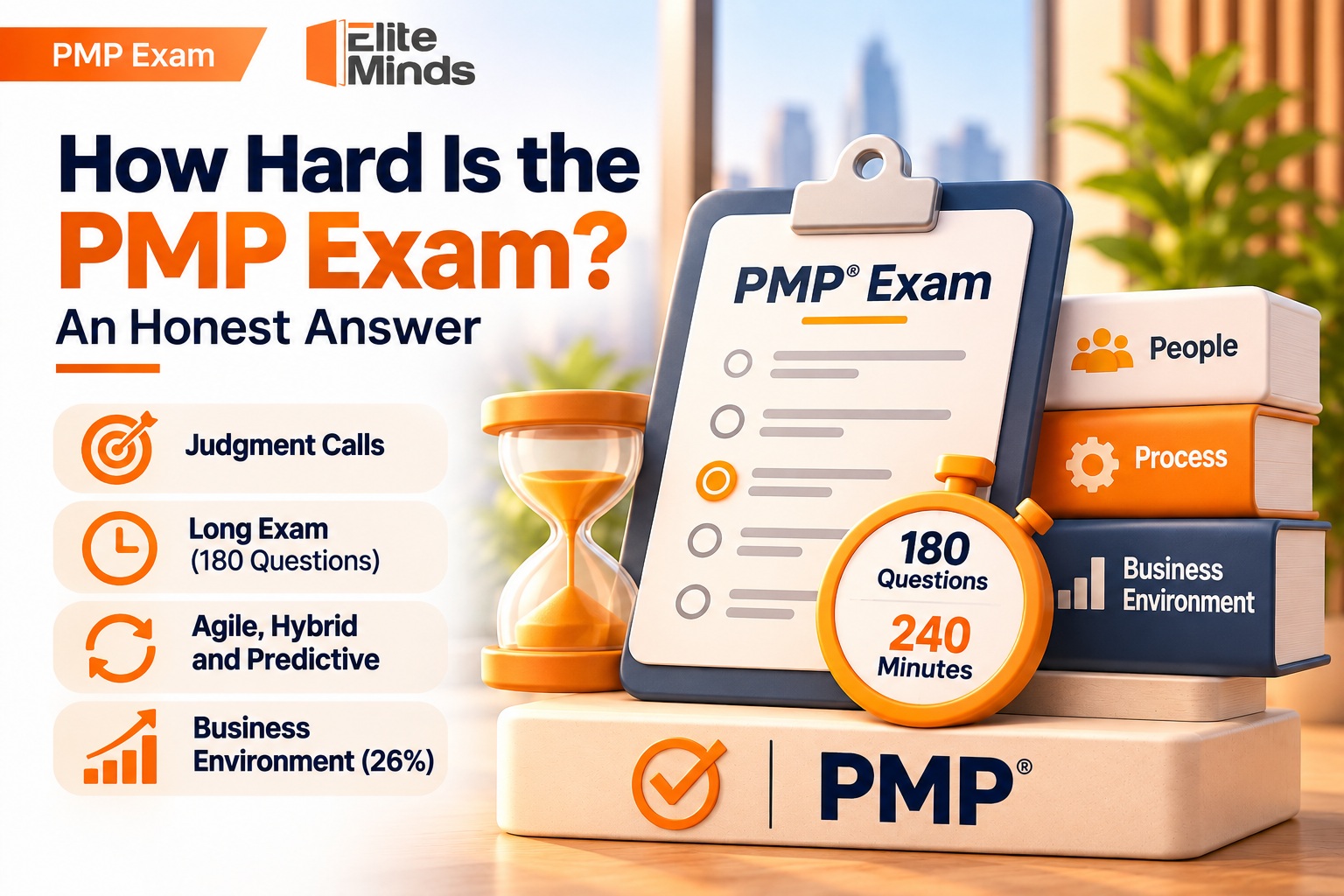
Twenty questions are a useful check, but they do not show your pacing or stamina. The real exam is 180 questions in 240 minutes, so the next step is a full timed test. For the full exam structure, see our PMP Exam Format guide.
Your next step
Ready for the full experience? Take our free PMP practice test: 180 questions, timed like the real exam, with feedback on your performance.
To see which topics deserve the most study time, read our PMP Exam Hot Topics guide. For structured preparation with eight full mock exams, see our PMP Exam Preparation Course.
Frequently asked questions
No. They are original practice questions written by Elite Minds in the style of the current exam. Real exam questions are confidential.
Most are situational multiple-choice questions. The exam also uses multiple response, drag and drop, hotspot, fill-in-the-blank, case study sets, and questions built around visuals such as dashboards.
180 questions, of which 170 are scored and 10 are unscored pretest questions. You have 240 minutes.
A longer scenario followed by three to five linked questions about the same project, like questions 18 to 20 above.
Yes, as part of normal scenarios. Questions 5, 12, and 16 show the kind of judgment they test. See our guides to AI topics in the PMP exam and sustainability questions in the PMP exam.
Aim for 80% or more, consistently, on full timed practice exams before you book the real one.